Do your team meetings feel like a waste of time? Does one person do all the talking while others stay quiet? Do you leave discussions with more confusion than clarity?
If this sounds familiar, you are not alone. Many leaders feel the pressure to have all the answers. They believe their job is to direct, command, and control. But this old-school approach often stifles the very talent they hired.
There is a better way. It is called facilitative leadership.
Facilitative leadership is not about being the smartest person in the room. It is about making the room smarter. It is a style where your main job is to guide the process of thinking, not to provide all the ideas. You become a catalyst for your team's success.
In this article, you will get a clear plan. We will break down the seven core practices of facilitative leadership. You will learn what each one means, see it in action, and understand how to use it to get better results from your team.
At its heart, facilitative leadership is a people-centered approach. The leader acts as a guide who creates an environment where every team member feels safe, heard, and motivated to contribute their best work.
A facilitative leader focuses on the how: How can we have a more productive meeting? How can we make sure we hear from everyone? How can we solve this problem together?
This is different from a traditional leader who focuses only on the what: What is the task? What is the deadline? What is the answer?
Let's clear up some common myths:
Facilitative leadership isn't an isolated concept. It is a powerful component of a larger shift in how we think about leading teams today. This style fits perfectly within the framework of modern leadership, which moves away from command-and-control and toward empowerment and agility.
In a comprehensive guide to Modern Leadership Styles for High-Impact Teams, several key styles are outlined that define today's successful leaders, including Servant Leadership, Democratic Leadership, and Transformational Leadership.
Let's see how facilitative leadership connects:
Think of facilitative leadership as the fundamental skillset that enables these other modern styles to work effectively. It's the concrete action behind the powerful philosophy.
The most basic shift for a facilitative leader is to replace statements with questions. Instead of giving answers, you draw out the wisdom that already exists within your team.
Why it works: Questions activate people's brains. They encourage analysis and ownership. When a team arrives at an answer themselves, they are far more committed to making it work. A study by the Harvard Business Review found that teams with leaders who ask more questions show higher levels of psychological safety and engagement.
How to start: In your next conversation, make a conscious effort to ask two questions for every directive you give.
This goes beyond just hearing words. Active listening means you are fully focused on the speaker. You are trying to grasp the meaning and emotion behind their words without planning your response while they talk.
Why it works: When people feel truly listened to, they feel valued. This builds immense trust and makes people feel safe to share half-formed ideas, which are often the seeds of innovation. A report by Salesforce found that employees who feel their voice is heard are 4.6 times more likely to feel empowered to do their best work.
How to start: Practice paraphrasing. After someone speaks, repeat the core of their message back to them in your own words to confirm your understanding.
Chaotic meetings are a productivity killer. A facilitative leader provides structure. They set a clear goal for each discussion and outline the steps the group will take to reach it.
Why it works: A clear process reduces anxiety. It tells people where they are going and how they will get there. This saves time, keeps everyone focused, and ensures you achieve your meeting objectives. Research from the University of North Carolina shows that agendas significantly improve meeting effectiveness and participant satisfaction.
How to start: For your next meeting, write a single, clear objective at the top of the agenda. Share it with the team at the start.
This does not mean you have no opinion. It means you temporarily set aside your personal views to serve as an impartial guide. Your primary role is to manage the discussion fairly, ensuring all sides get a fair hearing.
Why it works: When you neutralize your voice, you prevent your team from simply agreeing with the boss. This encourages constructive debate and leads to more thoroughly vetted, robust solutions. It signals that the best idea wins, not the loudest voice or the highest title.
How to start: In a discussion, make it a rule to hear from at least two other people before you share your own opinion.
The goal is not just a decision, but a decision that the entire team can support and will work to implement. Facilitative leaders test for consensus to ensure the group is aligned and ready to move forward together.
Why it works: Consensus-building does not mean unanimous agreement. It means everyone feels they were heard and agrees to support the group's decision. This eliminates silent sabotage and creates unified action. Teams that commit to decisions together execute them faster and more effectively.
How to start: At the end of your next decision-making meeting, explicitly ask: "Does everyone commit to supporting this path forward?"
Meetings can drain energy or create tension. A facilitative leader is like a thermostat, constantly reading the room's temperature. They know when to inject energy, when to take a break, and how to channel conflict into productive debate.
Why it works: High-performing teams have productive conflict. By managing the energy and framing disagreement as a positive force, you prevent personal attacks and keep the team focused on solving the problem, not each other.
How to start: Pay attention to body language. If you see slumped shoulders or crossed arms, name it and suggest a quick pause or a change of activity.
Throughout a discussion, ideas can become scattered. The facilitative leader acts as a synthesizer, pulling together the key points, themes, and decisions. They make the implicit explicit.
Why it works: Synthesis creates shared understanding. It is the final check that aligns the team and provides a clear record of outcomes and action items. This is the single biggest factor in preventing miscommunication after a meeting.
How to start: Make it a non-negotiable habit to spend the last two minutes of every meeting summarizing decisions and action items.
You do not need to master all seven practices at once. This is a skill set you build over time.
Facilitative leadership is powerful, but it is not the only tool. There are times when a more direct, top-down approach is necessary and right:
The best leaders know how to flex between facilitative and directive styles as the situation demands.
No. While it is most visible in meetings, it is a mindset you apply in one-on-ones, project planning, and even in how you assign work. It is about how you interact with your team every day.
Yes, it is critical for remote teams. The practices of creating a clear process, synthesizing, and managing energy are even more important when you cannot rely on casual office interactions. Using digital whiteboards and polls can enhance facilitation online.
This is common. Start with low-risk ways to contribute. Use a poll or a chat-based brainstorm first. Ask for thoughts in advance via email. Your job is to create such psychological safety that quiet team members feel it is safe to speak up.
Facilitation is a skill. Facilitative leadership is a style that uses that skill. You can hire an external facilitator to run a meeting, but as a leader, you use facilitation skills every day to lead your team.
Absolutely. You have full control over the culture you create within your own team. Your success will be a powerful example that may even influence your boss and others in the organization.
Becoming a facilitative leader is a journey that pays enormous dividends in team performance, morale, and results.
Your first step is small. Choose one of the seven practices, maybe Practice 1: Ask, Don't Tell, and try it in your very next team conversation.
Notice what happens. Then, share your experience. What question sparked the best discussion? What surprised you? Your story could inspire another leader to begin their own journey.
Ready to explore other ways to lead? Learn how facilitative leadership compares and combines with other powerful approaches in this guide to Modern Leadership Styles for High-Impact Teams.

By Dennis Ondrejka
This inspiring guide re-imagines leadership as an act of service rooted in empathy, humility, and purpose. Blending academic insight, personal stories, and practical tools, Servant Leadership equips readers to lead with heart and integrity-whether in the classroom, the boardroom, or everyday life. Drawing on timeless spiritual wisdom and modern research, Thibodeau and Ondrejka show how leading by serving can transform individuals, teams, and entire organizations. This is leadership as it was meant to be: good work, sacred work, our work.
Is your team full of great ideas that never get heard? Do you feel like you're making all the decisions alone? You might be searching for a better way to lead. That way is often called participative leadership.
This style is about sharing power. It means including your team in the decision-making process. But is it always the right choice?
This guide will give you a clear picture. We will explore the real advantages and disadvantages of participative leadership. You will learn how it boosts morale and sparks innovation. You will also see when it can slow things down. We will provide a simple framework to get started and show you when to use a different style.
By the end, you will know exactly how to use this powerful approach to build a stronger, more committed team.
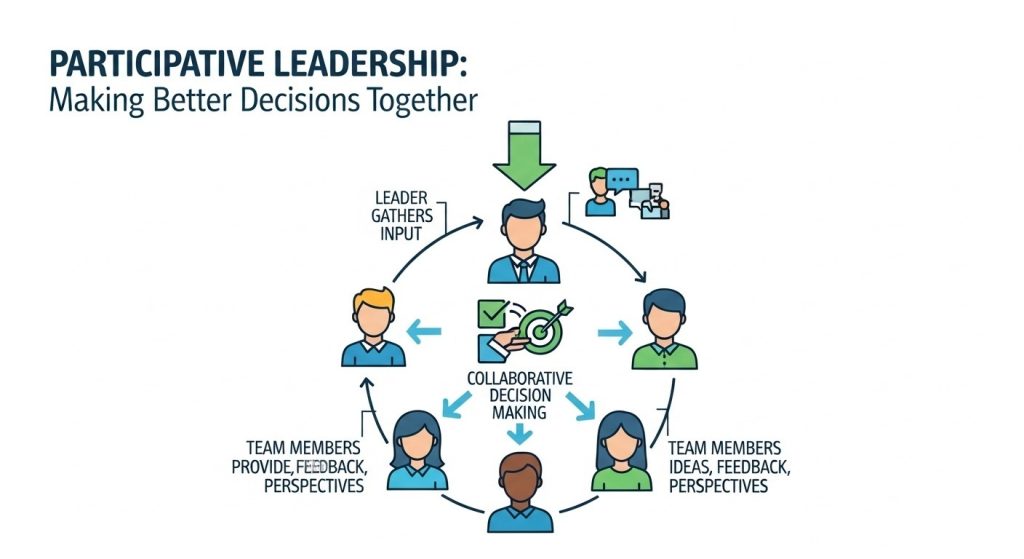
Participative leadership is a style where a leader involves their team members in the process of making decisions. It is not about letting everyone vote on everything. It is about gathering input, valuing perspectives, and building consensus before the leader makes the final call.
Think of it as the difference between a captain who shouts orders and a captain who gathers the crew to chart the best course together. The captain is still in charge, but they use the collective wisdom of the team to navigate.
This leadership model rests on a simple idea: people who help create a plan are more likely to believe in it and work hard to make it succeed.

The benefits of this approach can transform a team. Here are the most significant advantages.
When employees feel heard, they feel valued. This sense of value is a direct path to job satisfaction. People are not just following orders; they are contributing to a shared goal. This meets core psychological needs for autonomy and purpose. A happy team is a productive team that sticks around.
Different people have different viewpoints. When you open the floor to your team, you get a wider pool of ideas. A developer might see a technical solution you missed. A marketer might understand a customer angle you did not consider. This diversity of thought is the engine of innovation.
One person can only see so much. A team can see more. By including your team, you get to pressure-test ideas before they are put into action. They can point out potential risks, hidden costs, and better alternatives. This process leads to more robust, well-rounded, and effective decisions.
This is perhaps the most powerful advantage. When a team helps build a decision, they feel a sense of ownership over it. It becomes "our plan," not "the boss's plan." This ownership means team members will work harder to ensure the plan's success. They are emotionally invested in the outcome.
People do not leave companies; they leave bad bosses. A leader who ignores and silences their team will see high turnover. A participative leader builds loyalty and trust. Employees feel respected and are less likely to look for another job. This saves the organization huge costs in hiring and training.

For all its strengths, this style is not a magic wand. It has real drawbacks you must understand.
Gathering input, discussing options, and building consensus takes time. It is almost always faster for one person to make a quick decision. In a genuine emergency, like a fire alarm, a participative process is dangerous. Speed is the enemy of participation.
Some leaders fear they will look indecisive or weak if they ask for help. In some traditional corporate cultures, this perception can be a real problem. A leader must be confident enough to seek input without ceding their ultimate authority.
Not everyone will agree. Discussions can get heated. Without a skilled facilitator, the team can get stuck in a "decision paralysis," arguing in circles without reaching a conclusion. The leader must be able to manage this conflict and guide the group forward.
You might have a team member who is an expert in their field but hates group meetings. They may not want the pressure of decision-making. Forcing a reluctant employee to participate can cause stress and resentment.
Some decisions are simply not for everyone. Issues like layoffs, major financial transactions, or sensitive personnel matters cannot be debated by the whole team. Sharing too much information in these cases can be irresponsible and harmful.
Knowing when to use this style is as important as knowing how. Use this simple guide.
Use Participative Leadership When:
Avoid Participative Leadership When:
Ready to try it? Follow these steps to start practicing participative leadership today.
Step 1: Define the Problem Clearly.
Start by stating the issue that needs a decision. Be specific about the goal and any constraints, like time or budget. This focuses the discussion and sets clear boundaries.
Step 2: Choose Your Participation Method.
You do not have to involve everyone the same way every time.
Step 3: Facilitate an Open Discussion.
Create a safe space for sharing ideas. Your job is to listen, ask questions, and ensure everyone has a chance to speak. Do not judge ideas prematurely. Use a whiteboard to capture all thoughts visually.
Step 4: Make and Communicate the Final Decision.
This is the most critical step. After gathering input, you must make the decision. Explain your choice to the team, acknowledging their contributions. This shows you truly listened and closed the loop, building trust for the next time.
This style is perfectly suited for today's challenges.
If your leader uses this style, your job is to step up. Be prepared to share your honest ideas. Listen respectfully to your colleagues. Be committed to the final decision, even if it was not your personal favorite. The system only works with active, responsible participation from everyone.
In democratic leadership, the team often votes, and the majority wins. In participative leadership, the leader gathers input but retains the responsibility for making the final decision. It is less about voting and more about consulting.
Yes, but it often works best at the team or department level. Large, organization-wide decisions may use representative participation, like through a committee or employee representatives who provide input to senior leadership.
Decisions about team processes, project planning, solving complex problems, and setting team goals are ideal. These benefit from team knowledge and require strong commitment for implementation.
A good leader facilitates. You can gently interject by saying, "Thank you for those ideas, John. I'd like to hear what others think." Set ground rules at the start, like "one person at a time," to ensure a balanced conversation.
There is no single "best" leadership style. The most effective leaders are flexible. They use a participative style for complex, team-oriented problems and a more directive, autocratic style in emergencies or when clear, non-negotiable instructions are needed.
Participative leadership is a powerful tool for building a resilient, innovative, and loyal team. Its advantages in employee engagement and decision quality are profound. However, its disadvantages in speed and potential for conflict mean it is not for every situation.
The best leaders are not just one thing. They have a toolkit of styles and the wisdom to know which one to use.
Ready to expand your leadership toolkit? Explore our comprehensive guide on Modern Leadership Styles for High-Impact Teams to master other essential approaches like transformational, servant, and situational leadership. Learn how to blend these styles to meet any challenge and lead your team to peak performance.
By Dennis Ondrejka
This inspiring guide re-imagines leadership as an act of service rooted in empathy, humility, and purpose. Blending academic insight, personal stories, and practical tools, Servant Leadership equips readers to lead with heart and integrity-whether in the classroom, the boardroom, or everyday life. Drawing on timeless spiritual wisdom and modern research, Thibodeau and Ondrejka show how leading by serving can transform individuals, teams, and entire organizations. This is leadership as it was meant to be: good work, sacred work, our work.
Today’s leadership landscape is shifting from authority-driven models to collaborative, human-centered approaches. Modern organizations now thrive on trust, shared responsibility, emotional intelligence, transparency, and empowerment, not hierarchy. This evolution has paved the way for Modern Leadership Styles that prioritize people, purpose, and meaningful connections in the workplace.
This comprehensive guide brings together the most influential contemporary leadership approaches:
These approaches are interconnected, forming a new leadership paradigm where influence is earned, not imposed.
Leadership used to be about authority. Today, success comes from:
Modern leaders share six core traits:
Participative leadership is a style where team members actively contribute to decisions, strategies, and problem-solving. It boosts morale, creativity, and ownership because employees feel valued and engaged in shaping outcomes. However, it can slow decision-making and isn’t ideal for urgent or highly sensitive situations, as explained in the full guide on Participative Leadership Advantages and Disadvantages.
Facilitative leadership focuses on enabling teamwork rather than directing every move. A facilitative leader removes barriers, encourages open dialogue, and creates an environment where people can excel. This approach aligns with the core practices outlined in the Facilitative Leadership Practices Guide, which highlights how leaders can support collaboration and help teams thrive.
Distributed leadership is a model where responsibilities and decision-making are shared across the team instead of relying on a single authority. Each member contributes based on their strengths, allowing leadership to shift naturally as different tasks and needs arise. This creates a more collaborative, flexible, and high-performing team, as explained in our full guide on Distributed Leadership: The Secret to a Superpowered Team.
A shared leadership identity where everyone leads in their area of expertise. Collective leadership works best when teams embrace key characteristics such as shared purpose, distributed decision-making, mutual accountability, and open dialogue principles outlined in this guide: Characteristics of Collective Leadership
A system where leadership is based on expertise, not titles.
Principled leadership is the practice of guiding people through decisions grounded in clear, unshakeable values. It means acting with honesty, fairness, responsibility, and respect, even when the choices are difficult. To understand the core values that shape principled leaders, you can explore this full breakdown: Principled Leadership.
Principled leaders gain trust, credibility, and loyalty.
People follow leaders they can trust.
Positivity in leadership means using optimism, recognition, and steady encouragement to inspire action. It helps teams stay focused, motivated, and confident, as highlighted in the guide from Transcendent Seekers on effective positive leadership.
Leaders who express gratitude create more loyal, motivated, and secure teams.
What It Is
An empowering leadership style focuses on trust, shared responsibility, and personal growth. Instead of controlling every decision, empowering leaders guide, support, and encourage others to think independently. This approach builds confidence, strengthens teams, and creates an environment where people feel valued and motivated to contribute their best work.
Explore what emotional and professional leadership growth looks like in this article on leadership maturity.
It builds trust, reliability, and respect.
A leader prioritizes the growth and potential of team members.
A leadership style rooted in emotional intelligence, authenticity, and deep human connection.
A modern leader isn’t just one style. They blend:
| Core Concept | Leadership Connection |
| Participation | Empowers teams |
| Facilitation | Removes barriers |
| Distribution | Shares leadership |
| Integrity & Credibility | Builds trust |
| Gratitude & Positivity | Boosts morale |
| Emotion & Heart | Strengthens relationships |
| Discipline & Maturity | Provides stability |
| Meaning & Purpose | Inspires long-term commitment |
Modern leadership styles focus on collaboration, emotional intelligence, shared responsibility, and people-centered decision-making.
They improve team trust, engagement, innovation, and overall performance by moving away from a strict hierarchy.
It’s a style where team members actively contribute to decisions, ideas, and problem-solving.
Empowering leaders to build autonomy, confidence, and growth by delegating meaningfully and trusting their people.
Yes. Modern leaders blend different styles, participative, facilitative, principled, and emotionally based, to fit the needs of their team.
The best modern leaders are:
✔ Purpose-driven
✔ Emotionally intelligent
✔ Principled
✔ Collaborative
✔ Empowering
✔ Gratitude-filled
✔ Non-hierarchical
✔ Developmental and mature
Organizations that embrace these traits build stronger cultures, loyal teams, and sustainable success.
By Dennis Ondrejka
This inspiring guide re-imagines leadership as an act of service rooted in empathy, humility, and purpose. Blending academic insight, personal stories, and practical tools, Servant Leadership equips readers to lead with heart and integrity-whether in the classroom, the boardroom, or everyday life. Drawing on timeless spiritual wisdom and modern research, Thibodeau and Ondrejka show how leading by serving can transform individuals, teams, and entire organizations. This is leadership as it was meant to be: good work, sacred work, our work.
